 ▶ Watch on YouTube
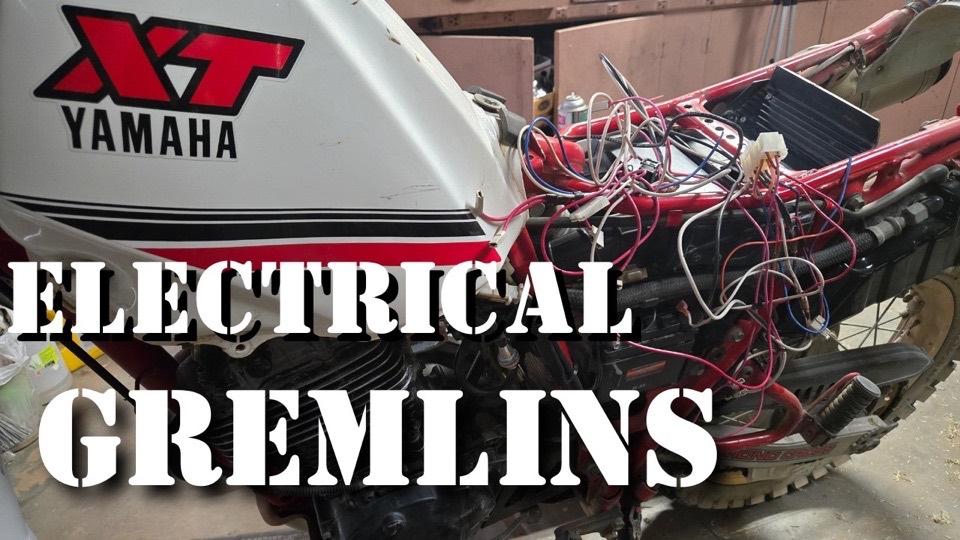
I've never had a lot of confidence, or luck, with electrical issues. The XT600 was the first bike where I found and repaired every electrical fault, and got multiple things from not working to working.
Confidence, one wire at a time
Electrical problems are difficult to track down, and they don't always have visual indicators. That said, they often do — and the more time I spend digging through wires, the more experience I gain and the more confidence I build.
I have new tools that help with diagnosing, like good jumpers and a multimeter, and I've gotten better at reading wiring diagrams. The XT is sort of the crux of those skills.
The more time I spend digging through wires, the more experience I gain and the more confidence I build.
- A 15-amp fuse, in place of a soldered-in 10-amp breaker.
- A new flasher relay.
- A new rear light bulb.
- A homemade horn button.
- One spare turn signal, swapped in.
A breaker that wasn't the right one
First, I found the original breaker was gone, and another had been soldered in its place. It was the same style as the original, but instead of using terminals, the wires were soldered onto the breaker. And it wasn't the correct amperage: it was 10 amps, where the bike needs 15.
So I decided to wire in a fuse of the proper size — 15 amps, as the bike needed.
That decision was really inspired by one of the soldered wires: it had snapped off at the post, so the circuit wasn't complete.
The breaker or fuse is there to cut the power before too much current can cook the wiring. The wrong amperage either trips when it shouldn't, or lets through more than the wires can take.
With that repair out of the way, I was able to get the lights to turn on.
Flashers and the tail light
The blinkers didn't work, and neither did the tail light. After trying a few things, checking connections and cleaning out corrosion, I determined I needed a new flasher relay — which turned out to be correct — and a new rear light bulb.
I could see the filament was burned out on one line but not the other. That was consistent with what the bike was doing: the tail light didn't work, but the brake light did.
A rear bulb like this has two filaments in one glass: a dim one for the tail light and a bright one for the brake light. One can burn out while the other keeps working.
After the flashers came back, one of the turn signals still didn't work. Luckily, the motorcycle came with two extras, so I swapped one in, and the flashers were all working.
A homemade horn button
Next up was the horn button. It was missing completely.
I got the horn button assembly apart, and after a few minutes of study, I figured out how it worked. I was able to make my own horn button and get it all to work.
I made it from an aftermarket switch I had lying around. The button didn't fit, so I had to file it and add a washer to get everything working. It took me around 90 minutes, but it works perfectly.
Street legal again
Now the electrical turns on, the flashers work, all the lights work, and the horn blares. With these fixes in, the motorcycle is back to street legal.
The flashers work, all the lights work, and the horn blares.