 ▶ Watch on YouTube
The head rebuild was one of the most unexpected parts of this rebuild. The damage to the original head was worse than I expected — and getting a replacement onto the bench took two tries and a bent stud.
The original head
For one, I didn't expect to find the level of damage to the original head. It probably would have run, but it was very damaged, and I didn't want to go forward with it long term.
There was serious wear to the cam, the cam races and the rockers. All the wear looked like it was due to heat and improper lubrication — not the raw miles of a well-running engine.
That difference is worth knowing how to read. Parts that wear out over years of normal running tend to wear smooth and even. Parts that run hot without enough oil get scored, galled and discolored — the metal surfaces rub directly on each other with nothing between them.
There was a large metal flake and many small flakes in the oil when I drained it. My guess is they came from the head.
What I think happened
This is all just a guess, but it's my take on the conversation with the seller and the condition of the engine and the motorcycle overall.
My guess is the owner's son hit a rock, all the oil drained out, and he kept running it — maybe he even just rode it home with no oil — and the damage was done. That would fit the large hole in the clutch cover from Uncovering damage without making it worse.
The father tried to repair the cases — the JB Weld was his repair, I assume — and it didn't sound right to him. There was oil in the bottom end when I got it, and I doubt the son did all that. I think the father wanted to keep the bike, his son damaged it, and he tried to save it but realized it was too late.
Not much rust. It looked well cared for. But the engine was cooked.
Finding a head
I ordered the best parts I could find on eBay, and as they came in I was mostly satisfied. But the head itself was first late, then never came.
I got a story from the seller that was just a lot of excuses — ones that should have had nothing to do with the part not being shipped. I don't know what his deal was. I was refunded, and I ordered another head — also from eBay.
The bent stud
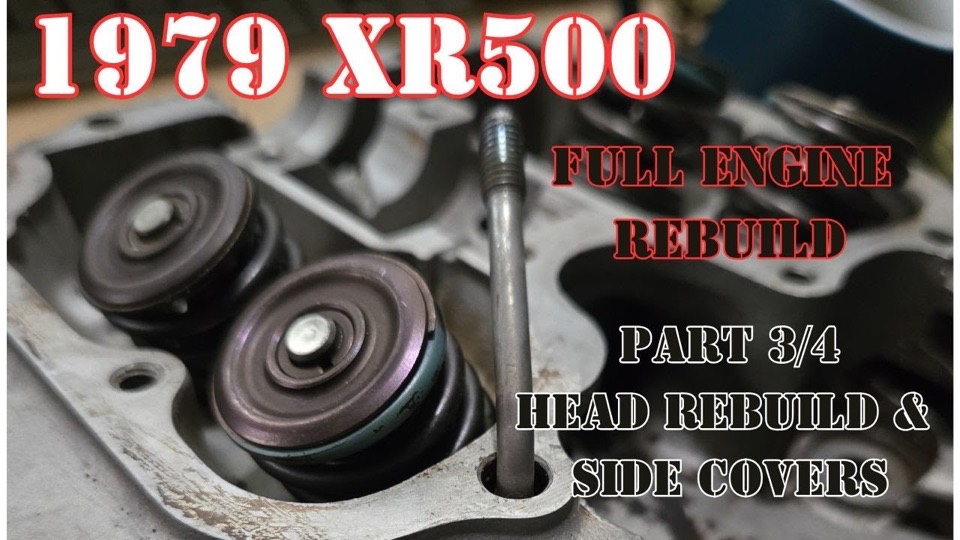
This time, the part was packaged incorrectly, and the alignment stud was bent in transport — or at least, my guess is it was during transport. In the listing, the stud was straight. When I got it, it was bent.
The package was damaged around the stud, and it was clear the seller had used shipping envelopes as packing material — not wadded-up paper, air pillows, bubble wrap, or anything more widely used.
A cylinder head is heavy, and a stud sticking out of it is the first thing to take a hit if the head shifts in the box. Packing that doesn't hold the head still leaves the stud doing the job.
Straightening it
I told the seller, and sent pictures of the head and the packaging. He didn't seem like a stand-up guy, and that's what led me to just try the part rather than file a claim with eBay. I figured I had a shot at avoiding another headache, and took a chance on myself being able to fix the part enough to use.
It helped that the stud is only there for alignment. Once the head is tightened down, it isn't really that critical — so it only had to be straight enough to line everything up.
Instead of returning the head and looking for yet another one, I straightened the stud. I used a torch and leverage to get it back to vertical, with as little visible variation as possible. Heating the stud first lets the metal bend back without cracking.
It took a while. But after I got everything in the head assembly to align and tighten down, I was satisfied it would work well.
Rebuilding the head
- New valve seals — the original valve seats stayed.
- A replacement cam. It was an expensive part to replace, so I bought the best-condition one I could find.
- Changed the rocker arms.
- A new cam gear and a new cam chain.
- Lapped in the valves.
- Set the valve clearances.
Lapping is grinding each valve against its seat with a fine paste until the two meet in an even, unbroken ring — that ring is what seals the combustion chamber when the valve is closed. Setting the clearances leaves the small gap the valve train needs, so the valves close fully as the engine heats up and parts grow.
Job well done
With the head back together, I closed up the engine — and took time to admire the fresh rebuild, now closed up on my workbench. Job well done!